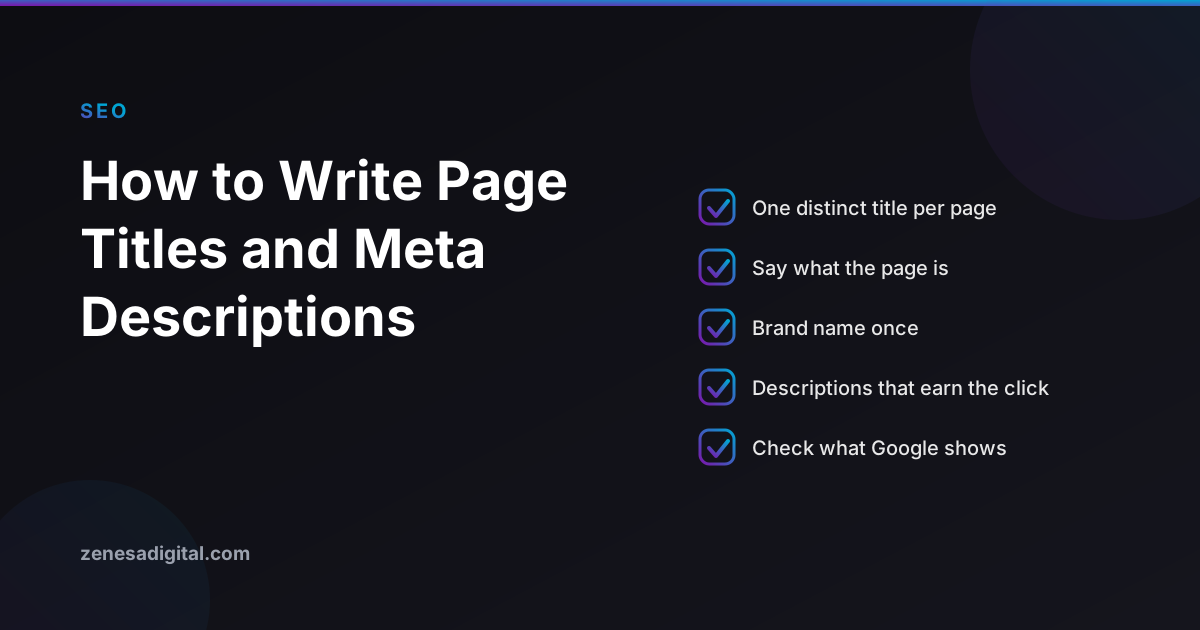
When someone searches for what you sell, the result they see is mostly two things: a blue title link and a couple of lines of text beneath it. Those come from your page title and, sometimes, your meta description. They cost nothing to change and they are read by every person who finds you in search, yet on many small business sites they are an afterthought or an exact copy of the page heading.
We build and optimise websites for a living, so we write these for every page we publish. This guide covers what Google itself says about both, the habits that follow from it, and the cases where Google ignores what you wrote.
What the title does
The title is the clickable headline in the results. In HTML it is the <title> element in the page head. Google says it uses several sources to decide on the final title link, including the title element, the main visual title on the page, heading elements such as the H1, the og:title tag, and the anchor text of links pointing at the page. The title element is the main input, but it is not the only one.
Two things follow. First, the title and the H1 should agree about what the page is, because Google can draw on either. Second, you control the title far more reliably when it is clear and accurate than when you try to be clever.
Write the title like this
- Describe this page, not the site. Google asks for distinct text that describes the content of each page. If your homepage title is the only one you have really thought about, the other pages are competing against each other with the same words.
- Lead with what the page is about. Put the topic or service first, then the qualifier. "Logo Design for Small Businesses" tells a searcher more than "Welcome to Our Website".
- Do not repeat yourself. Google notes that there is no reason to have the same words or phrases appear multiple times in a title. A list of near-identical keywords reads as spam to people and gives the search engine a reason to rewrite it.
- Add the brand name once. Google suggests the site name at the beginning or end, separated by a hyphen or pipe. Repeating it is a listed reason for a rewrite.
- Do not chase a character count. Google gives no limit and truncates as needed, and how much is shown depends on the device. Keep the important words early and the title short enough to read at a glance.
What the meta description does
The meta description is a short summary in the page head. Google documents it as an optional source for the snippet: it sometimes uses the description if that gives users a more accurate description of the page than content taken directly from the page. Snippets are generated for each search, so the same page can show different text for different queries. Google also does not document meta descriptions as a ranking factor.
That makes the job of the description narrow and worth doing well: persuade the right person that this page answers their question. A good one is specific, honest and written in plain sentences.
Write the description like this
- Be specific. Say what the page contains and who it is for. "A step-by-step guide to setting up Google Search Console for a small business site" beats "Learn more about our services".
- Make it unique. Identical descriptions across dozens of pages tell a searcher nothing. Google says that on large, database-driven sites you can generate descriptions from page data, which is fine as long as each one describes its own page.
- Avoid keyword lists. Clear, human-readable text is what Google asks for.
- Keep the promise. If the description says "free quote" and the page has no quote form, the visitor leaves and you have only trained people not to trust the result.
- Skip the length obsession. Google again gives no fixed number and truncates to the device width. Put the useful part first.
Why Google sometimes rewrites them
Do not be alarmed when the result does not match your tags. Google lists the situations that lead to a rewritten title: a title element that is empty or half-empty, text that is out of date, a title that does not describe the page, unclear pages with several prominent headings, a mismatch between the title and the page language, and a site name that is repeated. In most of those cases the fix is on your side, and a clearer title is the cure.
Descriptions are replaced even more freely, because the snippet is chosen to match the search. If a page covers several topics, expect different snippets for different queries. That is normal.
A worked example
Take a Houston dental practice with the title "Home" and no description. A better version for the homepage might be a title such as "Family Dentist in Houston, TX | Example Dental" and a description such as "Check-ups, cleanings and emergency appointments for adults and children in Houston. See our services, hours and how to book online." The title names the service and place first and the brand once. The description says what the page offers and gives a reason to click. Every other page, such as Teeth Whitening or Emergency Care, then gets its own pair rather than a copy.
How to check what you have
- View the page source and look for the title element and the
name="description"tag. - Search Google for the page and compare what is shown with what you wrote.
- In Google Search Console, look at the Performance report by page to see which pages get impressions but few clicks. Those are the first titles and descriptions to revisit.
- Make one change at a time and give Google time to recrawl before judging it.
Where this fits in your SEO
Titles and descriptions are one of the cheapest on-page jobs, but they are only part of the picture. If you want the wider view, read what SEO is and how it works, and use the small business website checklist to make sure the basics are covered across every page. If you would rather hand it over, our SEO services include writing these for every key page, or you can contact us and we will tell you what we would change first.