Ask five agencies whether you should spend your marketing budget on SEO or Google Ads and you will get five confident answers, most of them backed by a return-on-investment figure from the agency's own clients. We sell both services, so we are not neutral either. What we can do is show you how each channel actually works, using Google's own documentation rather than someone's case study, and give you a way to decide that does not depend on trusting anyone's numbers.
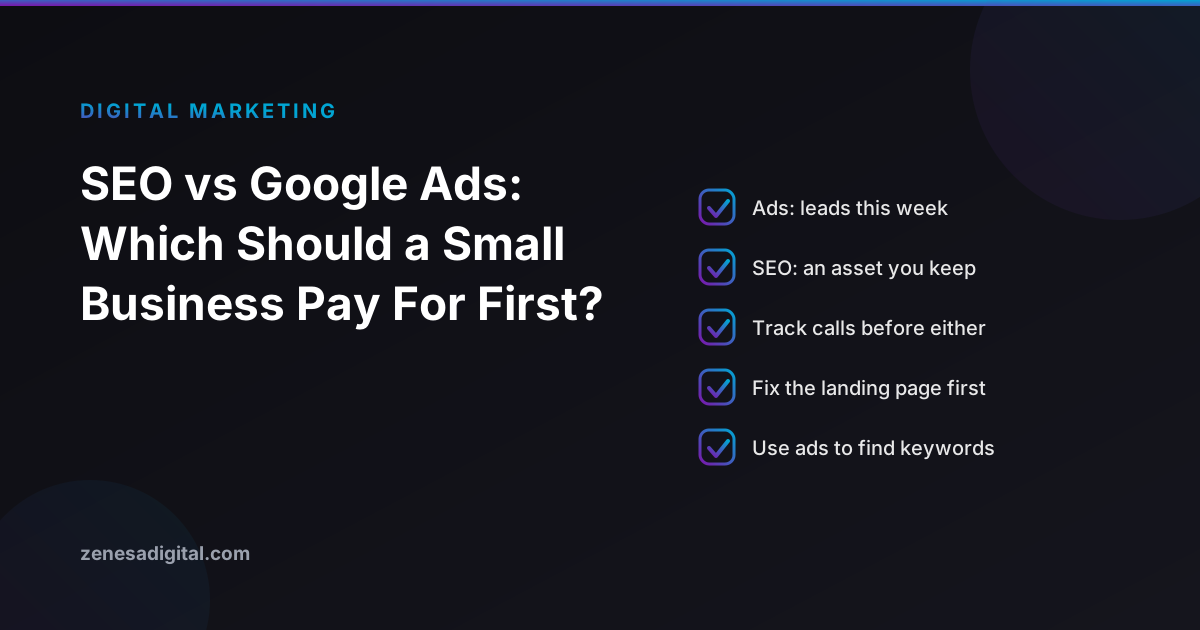
The short version: Google Ads rents attention, SEO builds an asset. Which one you fund first depends on how quickly you need enquiries, how much you can spend each month, and whether your website is ready to turn visitors into customers. Those three questions matter more than any benchmark.
What you are actually buying with each
Both channels put you on the same results page, but in completely different places and on completely different terms.
Google Ads places your ad in the sponsored slots above and below the unpaid results. You pay when someone clicks. The moment you stop paying, the ads stop showing and the traffic stops with them.
SEO is the work that makes your own pages eligible to rank in the unpaid results: the content, the technical health of the site, your Google Business Profile and the reputation signals around your business. You do not pay per click. You pay for the work, and the result keeps working after the work stops, although it fades if competitors keep investing and you do not.
One point is worth stating plainly because it is so often muddled: you cannot buy organic rankings from Google. Google's own documentation on how Search works says it "doesn't accept payment to crawl a site more frequently, or rank it higher." Spending on ads does not help your organic position, and pausing ads does not hurt it. They are separate systems.
How Google Ads really charges you
Most small business owners who have been burned by Google Ads were not burned by the channel. They were burned by not knowing three mechanics that Google documents openly.
1. You pay the price of the auction, not your bid
You set a maximum cost-per-click, but Google explains that your actual cost-per-click is "the final amount you're charged for a click", and that "you only pay what's minimally required to clear the Ad Rank thresholds and beat the Ad Rank of the competitor immediately below you." In practice your price is set by how many competitors are bidding on the same searches and how good their ads are. In a crowded local trade that can be expensive. In a niche it can be cheap.
2. Quality changes what you pay
The auction does not only look at money. Google lists auction-time ad quality, "including expected clickthrough rate, ad relevance, and landing page experience", among the factors that decide what you pay. That last one is your website. A slow, generic page that does not match the search makes every click harder to win and less likely to turn into an enquiry.
You will also see a Quality Score from 1 to 10 in your account. Treat it as a warning light, not a lever: Google describes it as "a diagnostic tool" and says plainly that "Quality Score is not an input in the ad auction." Chasing the number itself achieves nothing. Fixing the ad and the landing page it reports on does.
3. Your daily budget is really a monthly budget
This is the one that surprises people. Google says that "on a given day, your campaign might spend up to twice your average daily budget to take advantage of fluctuations of traffic", and that at the end of the month "you will have spent no more than 30.4 times your average daily budget." So a 50 dollar daily budget can spend 100 dollars on a busy Tuesday, and should be planned as roughly 1,520 dollars a month. If that monthly figure makes you nervous, the daily figure is too high.
The quiet budget leak: searches you never meant to buy
Broad keyword settings will show your ad for searches that are related to your keyword but not to your business. A plumber bidding on "plumbing" can end up paying for "plumbing apprenticeship" or "plumbing supplies near me." Google's answer is negative keywords, which, in its words, "let you exclude search terms from your campaigns." Reviewing the search terms report every week and adding negatives is the single most valuable habit in a small account, and it costs nothing but attention.
How SEO pays you back, and why it is slow
SEO has the opposite profile. It is slow to start, the timing is never guaranteed, and the early months can feel like spending money into a void. We cover the realistic timelines in detail in how long SEO takes to work, but the pattern is that a new or neglected site usually needs months, not weeks, before rankings translate into steady enquiries.
What you get in return is an asset. A service page that ranks for "emergency electrician in your city" keeps producing calls without a per-click charge. Content you publish once can answer customer questions for years. And the same work often improves your chances in the map pack and, increasingly, in AI-generated answers, which neither channel's ads can buy their way into in the same way.
The honest risks are just as real. Rankings can move after an algorithm update. A competitor with a bigger budget can outwork you. And no reputable agency can promise a specific position, which is why we would treat any guarantee of "page one in 30 days" as a reason to walk away. Our plain-English guide to how SEO works explains what the work involves if you want to judge a proposal yourself.
A side-by-side view
- Speed. Ads can show as soon as the campaign is approved. SEO typically takes months to build momentum.
- How you pay. Ads charge per click, on top of any management fee. SEO charges for the work, with no per-click cost.
- When you stop. Ad traffic stops the same day. Organic rankings usually decline gradually, if at all.
- Control. Ads let you choose exact searches, locations, hours and budget. SEO gives you influence, not control.
- Learning. Ads tell you within weeks which searches turn into customers. SEO data arrives slowly.
- Where you appear. Ads appear in the sponsored slots. SEO earns the unpaid results, the map pack and the sources AI answers draw on.
Which one to fund first: a simple decision guide
Skip the benchmarks and answer these questions about your own business.
Start with Google Ads if...
- You need enquiries this month, for example because you are launching, opening a new location or filling a quiet season.
- You are testing a new service and want to know whether people actually search for it before you invest in content.
- Your customers search with urgent intent ("24 hour locksmith", "same day AC repair") and choose whoever answers first.
- You can commit a monthly ad budget large enough to collect real data, and someone will watch the account every week.
Start with SEO if...
- You can wait several months for results and would rather build something you own than rent traffic indefinitely.
- The clicks in your market are expensive and a small ad budget would run out before lunch.
- Your customers research before they buy, reading guides, comparing options and checking reviews.
- Your website is thin, slow or out of date. Ads would send paid traffic to a page that loses it, so fixing the site pays twice.
Run both if...
You have steady demand and the budget for a real program. The most efficient pattern we see is to use ads for immediate enquiries while SEO builds, then use what the ad account teaches you. The search terms report shows exactly which phrases produce paying customers, which is the best keyword research money can buy. Build those phrases into your organic pages, and as they start to rank, reduce ad spend on the same searches if your organic listing is already capturing them.
The step most businesses skip: fix the destination first
Both channels send people to your website. If the website does not convert, you will conclude that the channel failed when the real problem was the page. Before spending on either, check the basics:
- Tracking. Can you count calls and form submissions, and tell which came from ads and which from organic search? Without this, every decision below is a guess.
- A matching page. Someone who searches "roof repair" should land on a roof repair page, not your homepage.
- Speed and mobile. Most local searches happen on phones. A page that loads slowly or is hard to tap wastes paid clicks and organic ones alike.
- A clear next step. A visible phone number, a short form, and a reason to act now.
Our small business website checklist walks through each of these. If the checklist turns up serious problems, fixing them is usually the best marketing spend available to you, because it improves the return on every channel you add later.
What a sensible budget looks like
We are not going to quote you a universal cost-per-click, because it varies enormously by trade and city, and most figures in circulation are one agency's averages. What does hold everywhere is the structure: with Google Ads you pay two bills, the ad spend that goes to Google and the management fee that goes to whoever runs the account. With SEO you pay for the work alone. Our guide to what digital marketing costs breaks down the published ranges by channel and explains why those two ad bills should always be quoted separately.
A practical rule for ads: work out the monthly figure first (remember the 30.4 multiplier), decide what one new customer is worth to you, and ask whether that budget can plausibly buy enough clicks to produce a handful of customers. If it cannot, a small SEO and website investment will usually do more with the same money.
The bottom line
Google Ads is a tap: fast, controllable, and it stops the moment you stop paying. SEO is a well: slow to dig, but it keeps producing. Most small businesses should not treat this as a permanent either-or. Pick the one that matches your timeline and budget today, make sure your website can convert the visitors either one sends, and let the data from one inform the other.
If you would like a second opinion on where your budget should go, our SEO team and digital marketing team can review your site and your market and tell you honestly which channel we would start with, including when the answer is "fix the website first". Get in touch and we will take a look.